

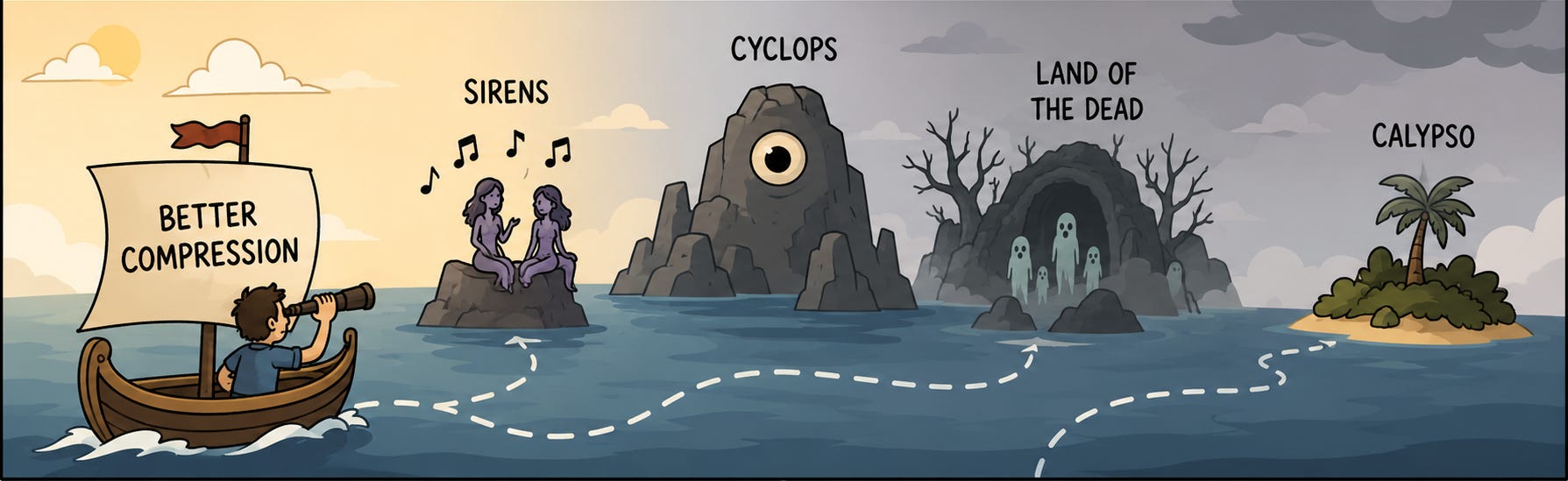
In the early days of Netflix streaming, before we built Netflix’s first large-scale encoding system, we were open to technologies that might reduce video bitrate without compromising quality. So we met with many companies claiming huge breakthroughs in video compression. This proved to be a perilous journey. Like Odysseus, we were drawn toward the rocks by the siren song of 50% bitrate reduction, and navigated cyclopean experts, hidden traps, no-win tradeoffs, paranoia, and plenty of snake oil. Along the way, we even took an Acid Rock trip. We made it through that treacherous voyage, and in the end, the lessons we learned gave rise to some industry-changing breakthroughs.
The Cyclops: Paranoia, Banding, and Buffer Overruns
Our first experience with codec magic was in the early days, before the Netflix Encoding Technology team existed. A startup convinced senior Netflix leadership to license their “video compression technology”, with claims of 50% bitrate reduction over x264, and the video team was given instructions to remove x264 and replace it with the new tech.
The company itself was tiny — just a handful of people — and the founder was… eccentric, and deeply paranoid about protecting his IP. He was convinced that foreign actors might steal the technology, and at his request, the engineer working with their encoder was placed in a locked lab environment with strict controls. I later learned that the video engineer had been explicitly instructed by the founder not to let me anywhere near it — something I only discovered after the fact.
Encouraging companies to isolate engineers is unusual and concerning enough. What happened next was worse.
We began seeing a high rate of hardware decoder crashes across CE devices. One of our software engineers dug into the streams and quickly spotted the issue: they weren’t respecting VBV constraints or even basic level limits. When we raised this with the vendor, their response was immediate:
“Be careful — you’re getting into our IP.”
Not exactly reassuring.
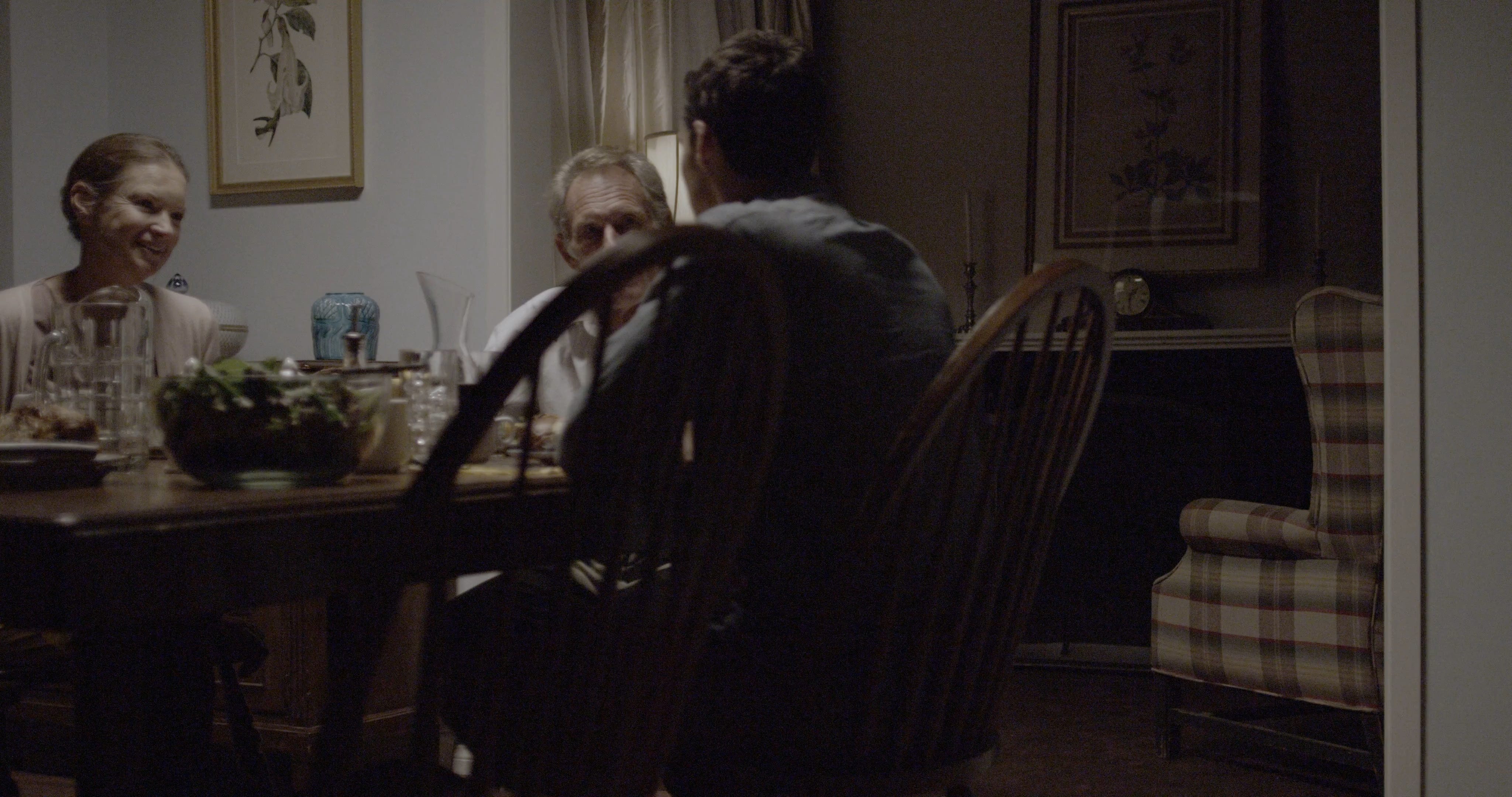
Around the same time, when House of Cards Season 1 launched, our Chief Product Officer raised concerns about severe visual artifacts — the worst banding I had ever seen. Not subtle gradients, but large, crawling bands across walls, with moving halos around people. It was unmistakably broken.
We brought the vendor in to review the issue. Their response was direct:
“We are video experts, and we are telling you that this is good video quality.”
After Netflix leadership left the room, things escalated. The founder accused me of attempting to steal his IP and claimed he had proof that I was reverse-engineering his IP (for the record, I never touched their binary, nor any of the output streams). He pointed his finger through the air into my face and said, “you’d better lawyer-up because it’s on, it’s on!”
Fortunately, there were witnesses to this crazy scene. Also, the “proof” was non-existent, and so the saga ended quietly. We removed the technology from the pipeline and reverted to plain x264. The cost of that detour was not trivial — licensing plus our dev costs and a lot of stress. It was an expensive lesson.
That experience led us to create a Hollywood-grade, open test clip scene painstakingly modeled after the House of Cards scene (Season 1, Episode 12, ~33:25) that exhibited the worst banding artifacts.
The Siren: A Beautiful Boxer
Though this was a failed experiment, we did not want to “throw out the baby with the bathwater” and so we agreed that we would continue to engage with compression IP companies.
The next experience was a little less weird — but just as instructive.
We engaged with another startup that claimed a 50% bitrate reduction over x264. That’s the kind of number you take seriously, so we provided a set of test clips and asked them to run their encoder.
At the face-to-face, they showed results based on our own content.
Overall, the quality wasn’t great. But one scene stood out.
One of our clips — El Fuente — includes a scene of a boxer in a ring. The boxer has noticeable acne and perspiration on his face. It’s a good test case: high detail, difficult textures, and very easy to spot when something goes wrong.

In the vendor’s version, the boxer looked… amazing.
Perfect skin. Smooth. Clean. Almost airbrushed.
All of the detail had been effectively low-pass filtered away.
It was a great demonstration of compression — just not the kind you want.
When we pointed out the quality issues, the response was immediate: they had a subjective quality metric that showed the output to be high quality.
When we asked for details, we were told — unsurprisingly — that the metric was confidential.
I was totally frustrated with video “experts” telling us to “ignore our lying eyes”. It was clear to me that the industry needed an open quality metric, and while complaining to a friend, he suggested that I speak to Prof. Kuo at USC, who was working on such a project. Our early conversations with Prof Kuo led to a partnership with USC which, along with a lot of work from the Netflix Video Technology team resulted in The VMAF Perceptual Video Quality Metric, the industry standard for subjective video quality.
Land of the Dead: Acid Rock meets Video Compression
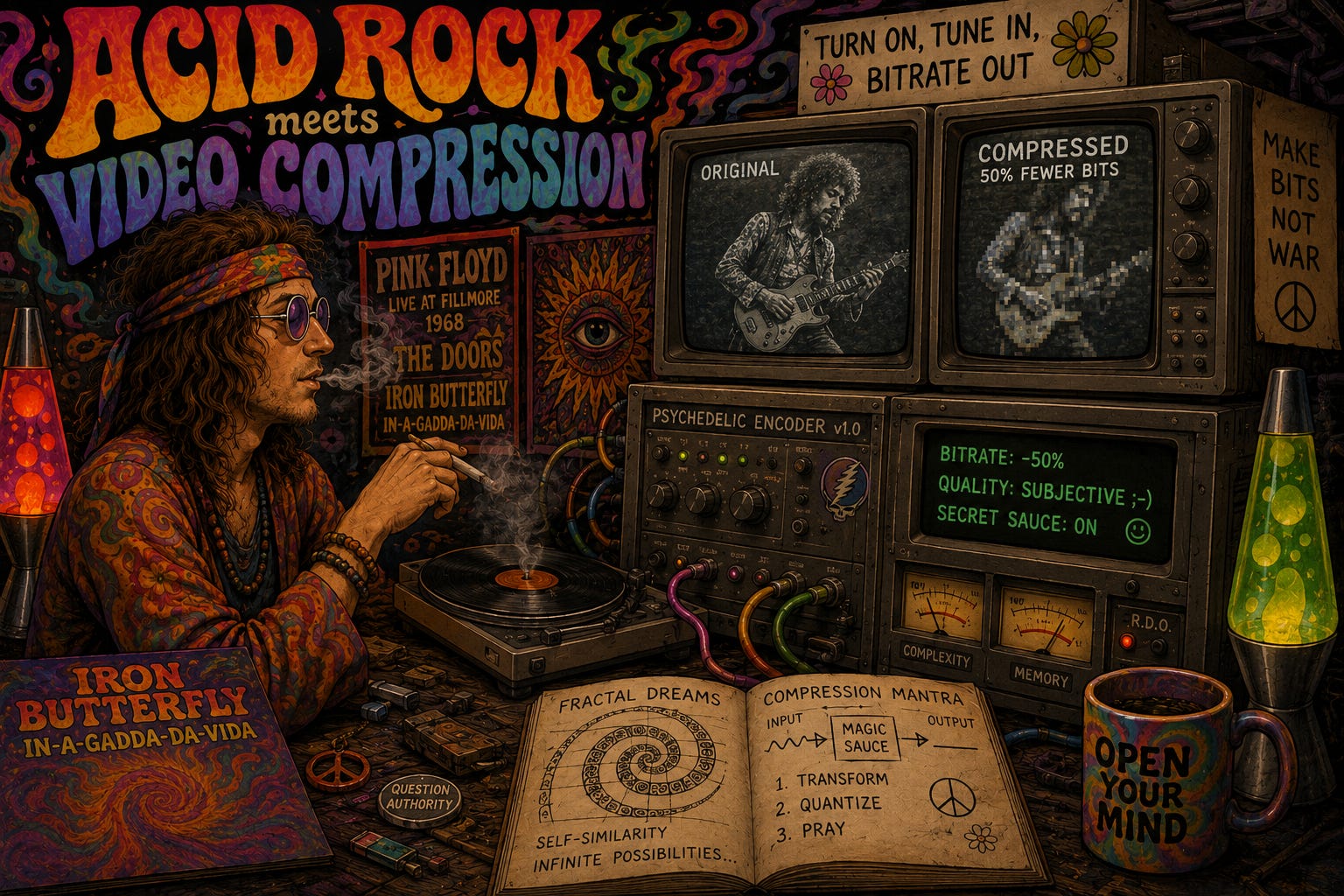
The next compression company on our odyssey led us somewhere unexpected: the Land of the Dead. This story began not with discussions about efficiency or RD curves, but acid rock, Iron Butterfly, and the 17-minute song In-A-Gadda-Da-Vida. It was a story about the band’s bassist, Philip Taylor Kramer, who we were told left music to pursue advanced image compression, culminating in technology behind Microsoft Encarta. The story took a darker turn with Kramer’s disappearance and apparent suicide, culminating in the dramatic reveal: a lost, revolutionary fractal-based video compression technology, decades ahead of its time, now rediscovered.
It was classic, compelling. Cinematic, even. It brought back old memories of my teen-angst younger self - surrounded by glowing posters in a room filled with UV light - listening to an endless drum solo. But this wasn’t a movie pitch and it was not teen nostalgia - it was about video compression technology for the Netflix transcoding system. It had to work.
Finally, drumroll… they showed the video.
The bitrate was higher than x264, and it looked terrible. But also… kind of fascinating. The artifacts weren’t the usual Lego-blocky mess you expect when compression breaks down. They were curved, C-shaped, almost organic - edges bending into arcs, textures folding into themselves, shapes that looked like they were trying to be right but weren’t quite. That’s when my video-nerd coworker delivered the iconic punchline: “it looks like sh#t… but it’s really cool.”
The meeting wrapped with a cast of characters that felt like they walked straight out of The Sopranos, eager to discuss a joint press release with Netflix. We declined and made a quick exit.
Enough Already!
Every new pitch seemed to come from the same playbook: 50% bitrate savings based on proprietary “breakthrough” technology, zero supporting data, and worst of all, “trust us, we’re the experts.” After the fractal pitch, we never engaged with another such company.
But through all of this, we kept working on the hard problems of video compression — not magic, not mythology, but measurable improvements grounded in data and perception.
Over time, those efforts led to technologies like VMAF, per-title encoding, and convex hull optimization.
In the end, the real breakthroughs didn’t come from secret codecs, lost fractal technology, or confidential quality metrics. They came from rigorous engineering, open measurement, and refusing to ignore what our eyes were telling us. And, of course, a truly exceptional Netflix crew that survived the perilous Odyssey.
It is curious how the video encoding business has attracted so many unscrupulous actors over the years. I suppose that the promise of dramatically reduced bitrates and claims of billions of dollars in potential streaming savings is seductive. I still see companies pitching massive compression breakthroughs built on existing codecs and proprietary “secret sauce.” They are easy to spot as they typically have no real video expertise among whatever people are public, and like Cold Fusion, their claims wither under minimal scrutiny.
My advice: Learn from our perilous journey. Avoid these carnival barker pitches like the Sirens on the Rocks. Nearly every major innovation in modern video encoding from companies like Netflix, Meta, and others has been openly shared through tech blogs, research papers, and conference presentations (Meta’s no-nonsense approach to codec comparisons is especially relevant for this conversation). Lean on these great Oracle(s) of Video Wisdom for your codec decisions.
[edit] Over the years, I engaged with serious, ethical, and legit codec companies and technology providers, which are often small companies or startups. I no way should such companies be grouped with the type I discuss here. How to tell the difference? The legit companies have video experts. They sell real and testable solutions, and do not make absurd and unprovable claims. For one great example, see the comparison graph in this paper.
Addendum - Calypso: The Seductive Paradise of AI Compression
The story wouldn’t be complete without mentioning AI compression.
In the past few years, I’ve met with several companies promising AI-driven codecs. No longer is “50% bitrate reduction” considered ambitious — the AI pitch is always 90%.
Like Calypso’s island, AI compression can feel like a seductive paradise: [sometimes] beautiful demos, extraordinary promises, and an escape from the hard realities of deployment. But eventually, every codec has to leave the island and survive the real world.
So far, most of the demos have failed to live up to the hype. They’ve been computationally expensive, operationally impractical, and underwhelming in real-world efficiency gains versus current codecs.
And that highlights the same lesson we learned years ago: a codec is not just a compression algorithm — it’s an ecosystem problem. Bitrate reduction is not especially useful if decoding requires hardware more at home in a gaming PC than a $100 Android device.
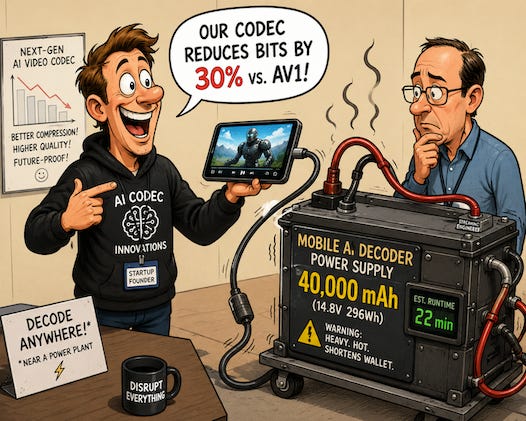
Still, we are early in understanding AI video compression, and I remain hopeful that major breakthroughs are possible. Will we reduce bitrate by 90% versus AV2? Very unlikely. But a 30% reduction versus AV2 with low-complexity decode would be enormously significant — especially if the decoder performed well on low-cost consumer hardware.
That’s why it’s important to remain open-minded about AI compression while staying grounded in measurable results and not swayed by smooth-talking con artists.
Exceptionally accurate and hugely entertaining writeup, David! I wouldn't expect anything less from you...
now do audio. ;)